
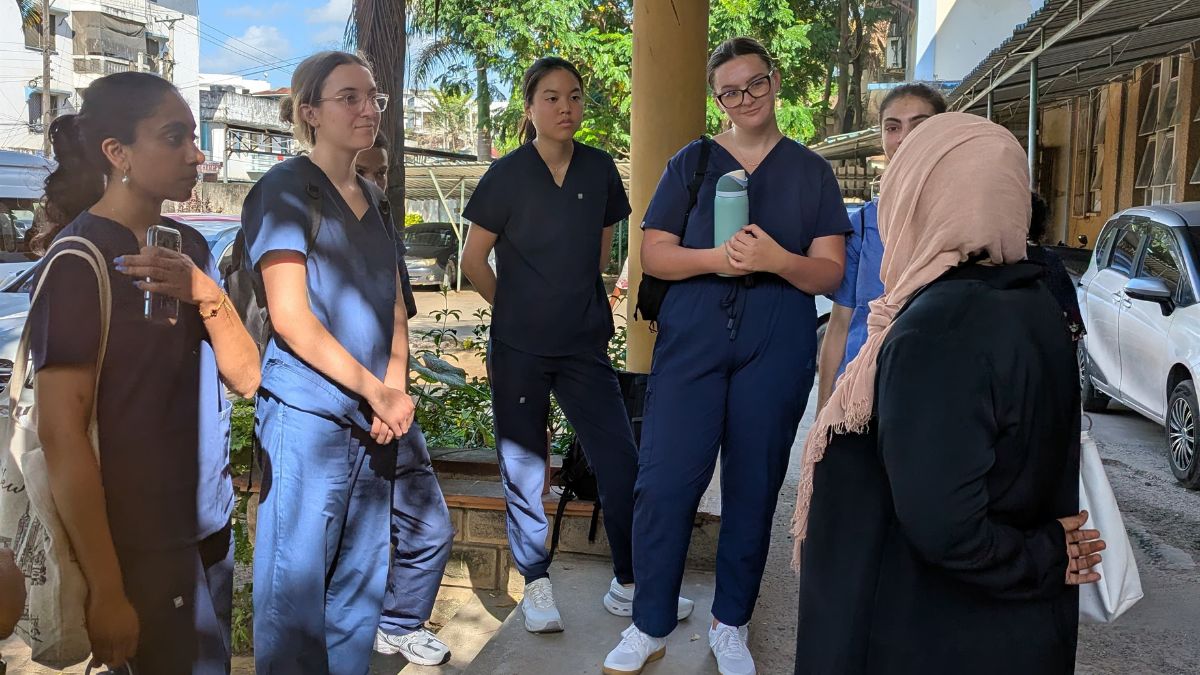
Pre-medical programs are not in short supply, and there is no doubt about their importance in shaping medical careers; the biggest question has always been whether shadowing doctors abroad is worth the time and money. As a provider running placements in Kenya and Tanzania, our answer is straightforward: it is worth it when three core conditions are met. This guide explains those conditions, what pre-health advisors recommend, what a typical day involves, the real challenges to plan for, and how to vet a program before you commit.
The short answer
Shadowing abroad is worth it when:
- You stay within your scope. You observe and, when the opportunity arises, help with tasks you are already trained for and that are ethically acceptable. Pre-med students have a narrower scope than senior medical students or residents on electives, so the rule is simple: you never perform a procedure you have not been trained to do.
- The learning is practical and structured. You have an assigned mentor, scheduled ward rounds, teaching sessions, and a log of what you saw and whether the placement met your expectations.
- You come home with a record of what you gained. You can describe specific cases you observed or took part in, including the symptoms, signs, diagnosis, treatment, and challenges. Those cases can serve as case studies in medical school and in admissions interviews, along with your reflections on how working in a different health system changed the way you think about patients, resources, and teamwork.
If a program fails on any of these, the money is better spent shadowing locally.
What pre-health advisors say
Pre-health advisors are cautious about international experiences, and with good reason. Princeton’s Health Professions Advising office notes that shadowing abroad is not required for medical school and advises pre-med students who do go abroad to choose ethical programs that follow AAMC guidelines (Princeton HPA). Those guidelines, the AAMC’s Guidelines for Premedical and Medical Students Providing Patient Care During Clinical Experiences Abroad, are clear: the main purpose of a clinical experience abroad is to learn through observation, and students should take on support tasks only after adequate instruction and under supervision (AAMC guidelines).
Admissions committees also look for core competencies such as service orientation, cultural competence, and teamwork (AAMC competencies for entering medical students). A structured global health placement builds all three. Our pre-health programs follow the AAMC standard: participants observe, help only with tasks within their training under the supervision of their hospital mentor, and never perform clinical procedures.
What it looks like day to day
Abby, a pre-med on our 2024 summer program, talks about rotating through hospital departments, global health tutorials and Swahili classes in Mombasa.
Justin Kim came on the program through the IIP program. He expected "another standard shadowing experience" as a silent observer. His placement at Coast General Teaching and Referral Hospital in Mombasa turned out more involved than that, but within clear limits.
"From learning about surgeries to getting accustomed to triage in the hospital, I was able to gain such great exposure in the field." — Justin Kim (read his full testimonial)
During a very busy shift in the emergency department, triage nurses were tied up and paramedics needed patients registered quickly so they could return to other calls. With the staff's encouragement, Justin stepped in to take patients' vital signs and help families through registration. That is the kind of contribution that is appropriate for a pre-health student: useful, supervised and within basic training. The staff, he says, encouraged students to help "not intrusively."
A typical weekday schedule of the Elective Africa pre-health program:
- 7:00 am: breakfast at the student residence, prepared by the program's chef.
- 8:00 am: driven to the hospital for a morning briefing with the supervising clinician.
- 8:30 am – 1:00 pm: rotations in your chosen departments: ward rounds, clinics, casualty, theatre observation.
- Afternoons: global health tutorials once a week (covering the ethical dilemmas local clinicians face), Swahili lessons twice a week, or a return to the hospital.
What you cannot easily get at home
Scarcity changes how medicine is practiced. Kenya has about 0.29 physicians per 1,000 people, against about 3.7 in the US (World Bank). You watch doctors reach a diagnosis with limited imaging and lab tests, and you see conditions rarely seen at home: malaria, tuberculosis, advanced HIV, and untreated trauma.
You also get to know a role most US students have never heard of: the Clinical Officer. Clinical officers are licensed mid-level clinicians, regulated by the Clinical Officers Council of Kenya under the Clinical Officers (Training, Registration, and Licensing) Act, 2017. They assess patients, diagnose illnesses, prescribe treatment, and refer complex cases, often with considerable autonomy where no doctor is present. Their closest US counterpart would be the physician assistant. Kenya has more than 30,000 registered clinical officers, and Coast General alone employs about 40. For pre-PA students especially, shadowing them shows what a non-physician clinician’s role can look like in a stretched system.
As Justin put it, people often assume an elective "is just a tourism package or that no actual learning happens." The difference comes from structure, supervision, and reflection.
The honest downsides
- Cost. A placement, plus flights, is a significant investment, especially when shadowing a local physician may be free. Weigh what you would gain abroad that you could not access at home.
- College credit and hours are not automatic. Most shadowing placements do not carry academic credit unless your university approves them before you travel, and medical schools differ on whether they count shadowing hours completed abroad. Ask your pre-health advisor or study abroad office first, and treat overseas hours as an addition to shadowing in the US, not a substitute.
- Overcrowding. Large regional public teaching and referral hospitals such as Coast General attract a large number of local and international trainees, especially in the summer. This can dilute your experience: the clinician you are shadowing may have many students attached to them, and you may not get their full attention. We work around this by placing students in less crowded departments and with clinicians who do not already have many students. We also advise students to plan their placements outside peak periods, such as late summer, the fall, late spring, or the first few months of the year. Coast General is our largest and most popular hospital, with established specialist departments and a constant stream of outpatients, which is why it is also the most crowded. If you prefer a quieter setting, our other partner hospitals in Mombasa, Nairobi, Kisumu, Migori, and Arusha offer the same structured placement with fewer students.
- Language barriers. English is an official language in Kenya and is widely used by hospital staff, but many patients speak Swahili or a local language. Staff and your mentor translate, and the twice-weekly Swahili lessons help, yet some conversations will pass you by.
- Cultural adjustment. The pace of work, the way difficult news is shared, and the role families play in patient care may all differ from what you know. Expect the first week to feel unfamiliar; your in-country coordinator and hospital mentor are there to help you settle in.
How to vet a shadowing program
Past students are a good source of information because they have firsthand experience. Ask them and the program these questions:
- Safety and security. Where will I live, how will I get to and from the hospital, and who is responsible for me outside it?
- Structure. Is there a written agreement with the hospital that defines what students may and may not do, and a set schedule of rotations and teaching?
- A point of contact in the hospital. Who is my named contact on the wards if something goes wrong during a shift?
- Support around the clock. Who do I call at 2 am?
- Evaluation. Will I get a logged record of hours and an end-of-program evaluation?
- Affiliations. Which universities send their students through the program?
Our answers: (1) a gated shared house with daily transport to and from the hospital; (2) a memorandum of understanding with each hospital and a structured schedule of rotations, global health tutorials, and Swahili lessons; (3) a named hospital mentor who is your point of contact on the wards; (4) 24/7 in-country staff; (5) a logged record of hours, an end-of-program evaluation, and a certificate after 50–60 hours; and (6) students from universities, including Princeton University, through its International Internship Program, and the University of Nebraska Medical Center.
Heidi Lee, who came through Princeton's pre-medical internship program, described what a working mentor looks like: "I never felt uncomfortable asking questions. Our hospital mentor was an amazing resource at the hospital, giving us introductions to the proper supervisors."
Paying for it
Many universities run global internship or summer funding schemes, so ask your study abroad or career office early, because deadlines often fall in winter for summer travel. You can also raise money from family, friends, and your community through a crowdfunding platform such as GoFundMe, which charges nothing to start a fundraiser; in the US, a processing fee of 2.9% plus $0.30 is deducted from each donation.
Ready to compare options? Read shadowing vs clinical practice, how to make shadowing abroad count, or see our pre-med shadowing programs in Kenya.
FAQ
Does shadowing abroad count for medical school? It can count as shadowing experience, but schools weigh it differently, and most still expect some shadowing in the US. Log your hours, keep your journal and ask your pre-health advisor how your target schools treat international experience.
Is shadowing abroad just voluntourism? It becomes voluntourism when students perform tasks beyond their training or when the host gains nothing. A responsible program keeps you within your scope, pays the host hospital and its mentors, and builds in teaching and reflection.
How long should I shadow abroad? We recommend three weeks for most pre-meds: long enough to settle in, rotate through more than one department and build a working relationship with your mentor. Two weeks is our minimum, and four weeks or more lets you see a wider range of cases.
Can pre-PA and pre-dental students shadow abroad too? Yes. Pre-PA students often shadow clinical officers and doctors, while pre-dental students shadow in hospital dental units such as Coast General's, which sees about 200 patients a day.