
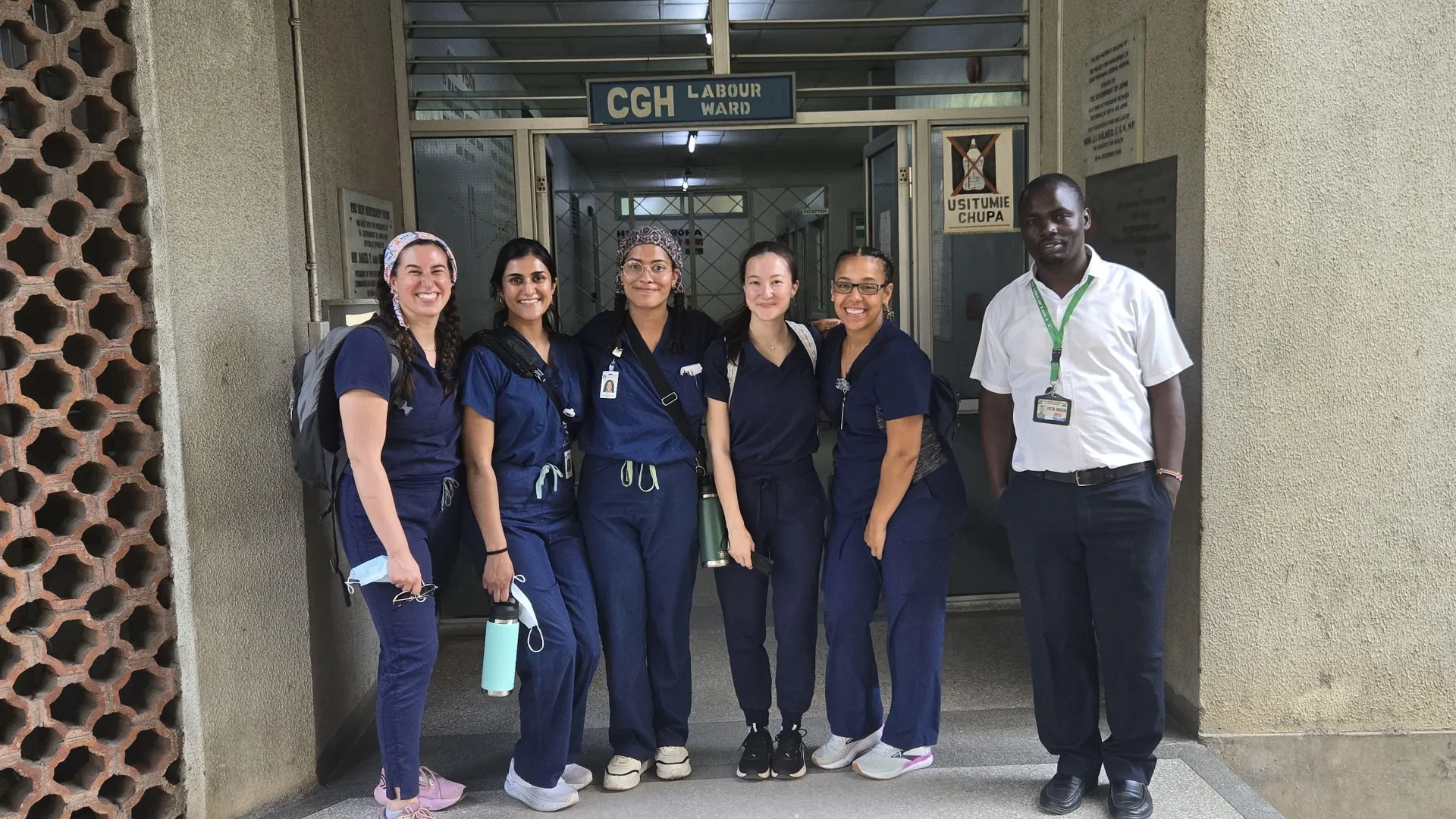
An overseas medical elective is still the exception for many medical students around the world. In the 2025 AAMC Graduation Questionnaire, only 13.6% of graduating US medical students said they had taken part in a global health experience during medical school (AMA). So what does an elective abroad actually add, and where does it fall short? Here are seven benefits our students report from placements in Kenya and Tanzania, followed by the limits that are worth knowing before you book.
1. More patients, earlier in your training
Public referral hospitals in East Africa are busy from the first hour of the day. A single morning can bring more patients than a week of outpatient clinics at home, and students often see the full course of an illness, from presentation to discharge. Sarah Dunalewicz, a medical student from Kansas City University, came to Mombasa for obstetrics and gynaecology: "I also got a lot of hands-on experience in OBGYN, which was fantastic."
Volume matters because pattern recognition comes from repetition. Seeing your twentieth case of a condition teaches you things your second case could not.
2. Sharper diagnosis with fewer tests
Where scans and laboratory results are limited or delayed, clinicians rely on the history and the examination, and they rely on them well. Students notice the difference quickly. Aubrey, a PA student from the University of Nebraska Medical Center, observed that clinicians in Kenya "are very knowledgeable about physical exam and how to diagnose based off of symptoms." Learning to commit to a working diagnosis before the results arrive is a skill that travels home with you.
3. Conditions you rarely see at home
Malaria, tuberculosis, advanced HIV, severe anaemia and untreated trauma are everyday work on an East African ward, and many patients present later than they would in Europe or North America. Reading about a disease and examining a patient with it are not the same thing. Tanaka Mavhunga, a medical student at the University of Nicosia who is now a GP specialty registrar, described "the many interesting cases and warm learning environment" that made him reluctant to leave the hospital at the end of each day.
4. A second health system to compare with your own
Working inside another health system makes you see your own more clearly. You learn how a referral system works when transport is a barrier, how families share in patient care, and how a team decides who receives a scarce treatment. Marina, a paediatrician and infectious diseases fellow from the University of São Paulo, found the most useful lesson was seeing how colleagues in a resource-limited setting "deal with that to manage infection prevention and infectious treatment." That comparison is hard to gain any other way.
5. Communicating across language and culture
English is widely spoken in Kenyan hospitals, but many patients are more comfortable in Swahili or a local language. You learn to work with interpreters, to watch body language, and to check understanding rather than assume it. Our students take Swahili lessons twice a week, and even a few phrases change how patients respond. Sarah Dunalewicz again: "I really loved the Swahili lessons and the extracurricular activities."
6. Evidence of the competencies selectors look for
Medical schools, foundation programmes and residency panels all ask for evidence of qualities such as adaptability, cultural competence, teamwork and resilience. An elective abroad gives you specific stories to tell, rather than unbacked general claims. The key is reflection: the weekly global health tutorials during the placement are designed to turn what you saw on the ward into something you can explain clearly in an interview.
7. Clarity about the doctor you want to be
Many students return with a firmer idea of their specialty, or of the kind of community they want to serve. Some discover a lasting interest in global health, infectious disease or emergency medicine. Others find that they want to work in primary care. Dr Mavhunga summed up his three weeks in Mombasa as "certainly a life-changing experience."
The limits
An elective abroad is valuable, but it is not the answer to everything. Be clear about these limits before you go:
- Your scope does not grow because you have travelled. You may only do what your stage of training and your medical school allow, under supervision. The WEIGHT guidelines for short-term global health placements are clear that students should never practise beyond their competence.
- Short stays have short reach. Two or three weeks is enough to learn a great deal, but not enough to change outcomes for a community. A responsible programme is honest about that.
- It is emotionally demanding. Seeing patients die of conditions that are treatable at home is hard. Plan to talk it through with your coordinator, your mentor and your peers.
- It costs money and time. Programme fees, flights and insurance add up, so weigh them against other ways of meeting your learning objectives.
- The host must benefit too. Choose a programme that pays the host hospital and its mentors and that follows the hospital's rules. Ours includes a hospital placement fee and a mentorship fee for every student.
How to get the most from an overseas elective
- Agree written learning objectives with your medical school before you travel.
- Bring your school's evaluation form so your mentor can complete it.
- Rotate through at least two departments, or stay in one if your objectives need depth.
- Attend the global health tutorials and ask the questions you could not ask on the ward.
- Keep a record of the cases you saw and what you learned from each.
For a closer look at what the placement involves, read a week on a medical elective in Mombasa, day by day, or explore our medical electives abroad.
FAQ
Is an overseas medical elective worth it? It is worth it when the placement is supervised, structured and honest about your scope. You gain clinical volume, sharper examination skills and experience of a different health system, which few of your peers will have.
Does an elective abroad help residency or foundation applications? It can, if you can explain what you learned and how it changed your practice. Selectors value specific reflection far more than a destination on a CV.
What do you learn on a medical elective in Africa? Students learn to manage conditions such as malaria, tuberculosis and HIV, to diagnose with limited investigations, and to communicate across language and culture.
How long should an overseas medical elective be? Our minimum is two weeks. Four weeks lets you rotate through two or three departments and build a working relationship with your mentor.